Imagine walking into a expert dermatologist office at 25 — not because you have wrinkles, but because you want to stop them before they start.
Welcome to the era of Baby Botox Treatment — a quietly explosive trend rewriting the rules of anti-aging. Once reserved for Hollywood stars in their 40s and 50s, Botox has migrated into the skincare routines of millennials and Gen Z, with some starting as young as 21.
According to the American Society of Plastic Surgeons, Botox procedures among people aged 20–29 increased by over 28% in recent years. Yet despite its surge in popularity, the conversation around preventative Botox remains rife with myths, half-truths, and social media-fueled misinformation.
So, is getting Baby Botox at 25 a genius long-term investment — or an unnecessary risk to a face that doesn’t need fixing yet?
We asked dermatologists, reviewed the science, and cut through the noise
What Is Baby Botox? (And How Is It Different?)
Baby Botox — also called micro Botox or preventative Botox — refers to the use of smaller, more diluted doses of botulinum toxin Type A injected into targeted facial muscles. The goal isn’t to freeze your face. It’s to soften natural expressions and, in theory, prevent the deep-set wrinkles that form over years of repetitive movement.
Baby Botox vs. Traditional Botox: Key Differences
Traditional Botox:
– Uses standard units and full doses
– Goal is to treat existing, visible wrinkles
– Produces a more dramatic, frozen look
– Requires touch-ups every 3–4 months
– Typically suited to patients aged 35–60+
Baby Botox:
– Uses reduced, micro doses
– Goal is to prevent future wrinkles before they form
– Delivers a subtle result with natural facial movement
– Requires touch-ups every 4–6 months
– Best suited to patients in their 20s to early 30s
Baby Botox is specifically designed to preserve natural expression while creating what practitioners call a “prejuvenation” effect — a portmanteau of prevention and rejuvenation that’s become a buzzword in modern cosmetic dermatology.
Why People in Their 20s Are Turning to Botox
The Social Media Effect
Let’s be direct: Instagram, TikTok, and YouTube have fundamentally changed how young people think about their faces. High-definition cameras, beauty filters, and the constant visual comparison of curated images have created unprecedented anxiety around skin aging — even among those in their early 20s.
Influencers openly documenting their Botox journeys have destigmatized the treatment, making it feel as routine as a teeth-whitening appointment.
The “Prejuvenation” Philosophy
Dermatologists have long known that wrinkles are partly caused by dynamic movement — the repetitive contraction of facial muscles when you smile, squint, or frown. Over decades, these contractions leave permanent lines in the skin.
The logic behind preventative Botox is straightforward: relax the muscle early, and you reduce the depth of the crease before it becomes permanent. This is not science fiction — it’s a reasonable extension of well-established dermatological principles.
Gen Z’s Proactive Skincare Mindset
Younger generations are arguably the most skincare-educated demographic in history. They’re applying SPF at 16, using retinoids at 22, and researching collagen peptides before they hit 25. Preventative Botox fits logically into this “offense over defense” mindset toward aging.
Is 25 Too Early? Here’s What Dermatologists Actually Say
This is the question — and the answer isn’t a simple yes or no.
The Case FOR Starting in Your 20s
– Dynamic wrinkles are easier to prevent than treat. Board-certified dermatologist Dr. Shereene Idriss has noted that treating fine lines in their earliest stages requires fewer units and produces more natural results.
– Muscle memory matters. Years of repeated squinting or frowning create a “groove” in the skin. Starting Botox early may reduce the long-term depth of these lines.
– Lower doses are often sufficient. At 25, the skin has high collagen density, meaning even micro doses can produce visible preventative effects.
– Some patients in their 20s have genetically predisposed early lines, particularly around the forehead and eyes. For them, early intervention is medically reasonable.
The Case AGAINST Starting Before You Need To
– If you have no visible lines at rest, there’s nothing to prevent yet. Many dermatologists argue that Botox at 25 is simply unnecessary for most people with healthy, unlined skin.
– There are no long-term studies on starting Botox in your 20s. The procedure has a strong safety record, but its effects over a 30–40 year span beginning in young adulthood are not yet fully documented.
– Psychological dependency is a real concern. Starting early can normalize an appearance that requires ongoing treatment to maintain — creating a financial and psychological cycle that’s hard to exit.
The expert consensus: Most dermatologists agree that the right age to start Botox is when you begin to notice consistent lines at rest, not when your skin is still completely smooth. For some people, that’s 28. For others, it’s 35.
The Risks and Downsides Nobody Talks About
- Muscle Atrophy With Long-Term Use
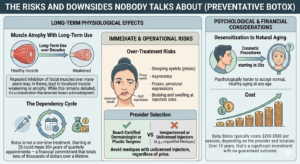
Repeated inhibition of facial muscles over many years may, in theory, lead to localized muscle weakening or atrophy. While this remains debated, it’s a consideration that deserves honest acknowledgment.
- The Dependency Cycle
Botox is not a one-time treatment. Starting at 25 could mean 30+ years of quarterly appointments — a financial commitment that totals tens of thousands of dollars over a lifetime.
- Over-Treatment Risks
In inexperienced or unlicensed hands, even “Baby” doses can cause:
– Drooping eyelids (ptosis)
– Asymmetry
– Frozen, unnatural expressions
– Bruising and swelling at injection sites
Always choose a board-certified dermatologist or plastic surgeon. Avoid medspas with unlicensed injectors, regardless of price.
- Desensitization to Natural Aging
There’s a broader psychological risk worth naming: starting cosmetic procedures in your 20s may make it psychologically harder to accept normal, healthy aging at any age.
- Cost
Baby Botox typically costs $200–$500 per session, depending on the provider and location. Over 10 years, that’s a significant investment with no guaranteed outcome.
Who Should Actually Consider Preventative Botox?
Baby Botox may be genuinely appropriate for you if:
– You’re 25+ and already see fine lines at rest (not just when smiling or squinting)
– You have a strong genetic history of early, deep facial wrinkles
– You’re a consistent sun-squinter or have highly expressive facial habits
– You’ve already optimized your skincare routine and want the next level of prevention
– You’ve consulted a board-certified dermatologist who confirms it’s clinically appropriate
Baby Botox is NOT recommended if:
– You’re under 21
– You have no visible lines and no family history of early wrinkles
– You’re pregnant or breastfeeding
– Your primary motivation is social pressure or comparison, not personal medical reasoning

Smarter Alternatives to Baby Botox in Your 20s
Before committing to a needle, consider that the most powerful anti-aging tools are often the most accessible ones.
Broad-Spectrum SPF (Daily, Non-Negotiable)
UV radiation accounts for up to 80% of visible facial aging, according to research published in Clinical, Cosmetic and Investigational Dermatology. A daily SPF 30–50 is, by a wide margin, the most evidence-based anti-aging intervention available.
Retinoids
Prescription-strength tretinoin and over-the-counter retinol remain gold-standard ingredients for stimulating collagen, accelerating cell turnover, and softening early lines. Starting retinoids at 22–25 is genuinely supported by dermatological science.
Antioxidant Serums (Vitamin C)
A well-formulated Vitamin C serum neutralizes free radical damage from UV and pollution, supports collagen synthesis, and brightens skin — all without a single needle.
Lifestyle Factors That Outperform Products
– Quitting or avoiding smoking (dramatically accelerates collagen breakdown)
– Quality sleep (7–9 hours of sleep supports skin repair)
– Hydration and a low-glycemic diet
– Blue light and screen management (emerging concern for eye-area skin stress)
Expert Tips for Preventative Aging Without Overdoing It
- Build a consistent morning and evening skincare routine anchored by SPF, Vitamin C, and retinoids before ever considering injectables.
- Get a professional skin assessment from a board-certified dermatologist — not a medspa sales consultant — before pursuing any cosmetic treatment.
- Ask about “micro-dosing” options if you do proceed with Botox. Less is almost always more in your 20s.
- Space your treatments conservatively. Resist the urge to treat every expression line. Some movement in the face is what makes you look human — and young.
- Photograph your progress. Tracking your skin over 6–12 months gives you objective data to guide decisions rather than acting on anxiety.
- Treat the whole lifestyle, not just the face. No cosmetic treatment compensates for chronic sleep deprivation, sun damage, or high stress.
The Honest Verdict on Baby Botox at 25
Baby Botox is not the reckless vanity project its critics suggest — nor is it the miracle prevention strategy its proponents sometimes claim.
For the right candidate, at the right age, in the right hands, preventative Botox is a medically reasonable option. If you’re in your mid-to-late 20s, already seeing consistent lines at rest, and have exhausted the fundamentals of skincare, a conservative Baby Botox treatment could genuinely slow the progression of dynamic wrinkles.
But if your skin is smooth, your SPF game is non-existent, and you’re being swayed by an influencer’s “before and after” reel — the needle can wait. The most powerful anti-aging intervention available in your 20s is still a bottle of sunscreen and a tube of tretinoin.
The real “brutal truth” about Baby Botox? It works best when you don’t need it much yet — and that means the decision should be driven by your skin, your genetics, and your dermatologist, not your For You Page.
FAQ
Q1. Is Baby Botox safe at 25?
Ans. Yes, Baby Botox is generally considered safe at 25 when administered by a board-certified dermatologist using appropriate micro-doses. However, safety also depends on your individual skin condition, medical history, and the skill of the injector. At 25, most people have minimal need for treatment, so professional assessment before proceeding is essential.
Q2. Does preventative Botox actually work?
Ans. Evidence suggests it can. By relaxing the muscles responsible for dynamic wrinkles before those wrinkles become permanently etched into the skin, early Botox may reduce their eventual depth. However, long-term studies specifically on preventative use in young adults are still limited, and results vary significantly between individuals.
Q3. How long does Baby Botox last?
Ans. Baby Botox typically lasts 3–5 months, slightly longer than traditional Botox in some cases due to the more conservative dosing. First-time users may find the effects wear off faster, while those who treat consistently over time may experience longer intervals between sessions.
Q4. Can Botox prevent wrinkles permanently?
Ans. No — Botox does not permanently prevent wrinkles. It temporarily inhibits muscle movement, which reduces wrinkle formation during that window. Without continued treatment, normal muscle function and wrinkle development resume. Long-term consistent use, however, may reduce the overall depth of lines over time.
Q5. What is the best age to start Botox?
Ans. Most dermatologists recommend starting Botox when you first notice consistent lines at rest — not just during expression. For most people, this falls between late 20s and mid-30s. There is no universal “right age”; it’s a decision best made in consultation with a qualified medical professional based on your skin type, genetics, and lifestyle.
Q6. What’s the difference between Baby Botox and regular Botox?
Ans. Baby Botox uses smaller, diluted doses of botulinum toxin to achieve a subtle, natural-looking result, compared to standard Botox which uses full doses for more pronounced muscle relaxation. Baby Botox allows greater facial movement and expression, making it better suited for younger patients seeking prevention rather than correction.
Q7. Are there non-Botox alternatives for wrinkle prevention in your 20s?
Ans. Absolutely. Daily broad-spectrum SPF is the single most effective anti-aging measure available. Prescription retinoids (tretinoin), topical Vitamin C serums, adequate sleep, no smoking, and staying well-hydrated all deliver clinically meaningful anti-aging benefits — without injections, cost, or risk. For most people in their 20s, these steps should precede any discussion of Botox.