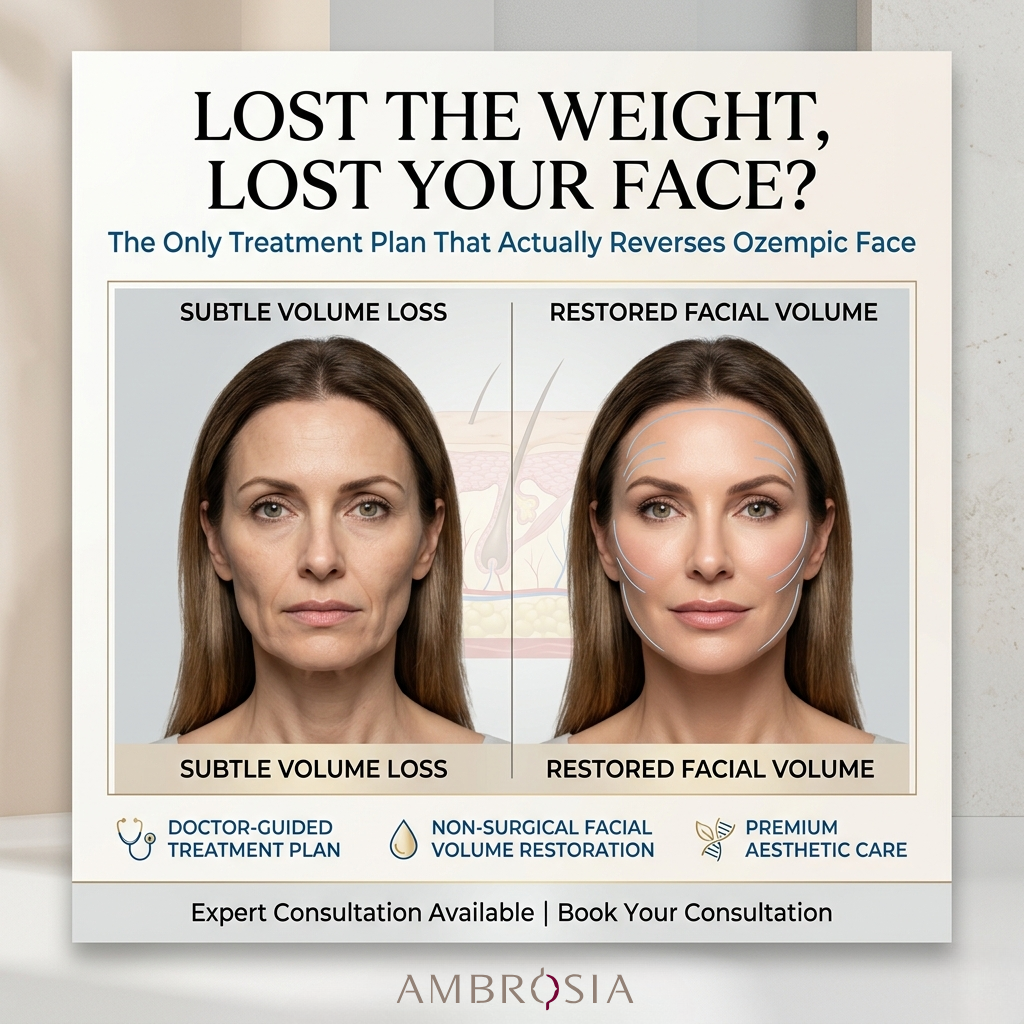
You finally hit your goal weight. You feel lighter, healthier, and more confident in your clothes. But when you look in the mirror, the person staring back looks… tired. Maybe even a decade older than before you started your journey.
If you’ve noticed hollowed cheeks, sagging skin, or a “sunken” appearance after using GLP-1 medications, you aren’t alone. This phenomenon, colloquially known as “Ozempic Face,” is the most talked-about side effect in the aesthetic world today.
Many people rush to their dermatologist asking for Botox Treatment , hoping for a quick lift. But here is the hard truth: Botox alone cannot fix Ozempic face. In this guide, we’ll dive into why your face changed, why Botox isn’t the silver bullet, and the exact treatments that actually work to restore your youthful volume.
What Is “Ozempic Face”? (And Why Everyone Is Talking About It)
Ozempic face is a term that went viral after countless patients on GLP-1 receptor agonist medications — like semaglutide (Ozempic, Wegovy) and tirzepatide (Mounjaro) — reported that their faces appeared dramatically older, gaunt, and deflated after significant weight loss.
The phrase was first coined widely in media and dermatology circles around 2022–2023, when plastic surgeons and aesthetic doctors began reporting a sharp uptick in patients seeking facial rejuvenation treatments specifically after GLP-1-induced weight loss.
To be clear: Ozempic face isn’t caused directly by the medication itself. The drug doesn’t target your face. What causes the facial changes is the rapid weight loss that the medication produces. When your body sheds fat quickly — sometimes 15–30% of body weight in under a year — the fat pads in your face disappear along with the fat everywhere else.
Your face loses its scaffolding.
Think of facial fat like the stuffing inside a cushion. When the stuffing shrinks, the outer fabric (your skin) doesn’t shrink at the same rate. The result? Drooping, sagging, hollowness, and a sudden appearance of fine lines and wrinkles that weren’t visible before.
Signs You May Have Ozempic Face:
- Hollow or sunken cheeks
- Deep tear troughs (dark circles under the eyes)
- Jowls or sagging along the jawline
- Thinning lips or loss of lip volume
- Visible nasolabial folds (smile lines)
- Loose or crepey skin around the neck and chin
- General gaunt or “deflated” facial appearance
Why Rapid Weight Loss Changes Your Face
To understand the fix, you need to understand the problem at a deeper level.
Your face is a layered, three-dimensional structure made up of skin, subcutaneous fat, muscle, and bone. Each of these layers works together to give your face its youthful, full appearance.
Here’s what happens to each layer during rapid weight loss:
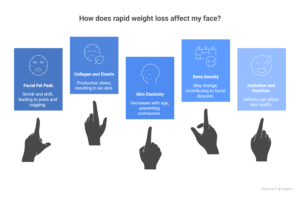
1. Facial Fat Pads Shrink and Shift
Your face contains multiple distinct fat compartments — in your cheeks, temples, under-eyes, and around your jaw. These fat pads naturally decrease in size with age, but rapid weight loss accelerates this process significantly. The fat doesn’t just shrink evenly — it can shift downward, contributing to jowls and sagging.
2. Collagen and Elastin Production Slows
Rapid weight fluctuations stress the skin’s collagen and elastin fibers — the proteins responsible for keeping your skin firm, bouncy, and smooth. When fat volume drops quickly, collagen can’t regenerate fast enough to keep up, resulting in lax, saggy skin.
3. Skin Loses Elasticity
Younger skin bounces back after changes in volume. But as we age, our skin loses its elasticity. If you’re over 40 and losing weight rapidly, the skin on your face simply won’t contract to the new, smaller facial structure underneath it. This is why older patients are significantly more affected by Ozempic face than younger ones.
4. Bone Density Changes
Long-term GLP-1 use has been associated in some studies with potential changes in bone metabolism. While this research is still evolving, loss of bony support in the midface area can further contribute to facial descent and an aged appearance.
5. Hydration and Nutrition Deficits
People on GLP-1 medications often experience significant appetite suppression. This can sometimes lead to reduced intake of essential nutrients — including proteins, healthy fats, and hydration — all of which are critical for maintaining healthy, youthful-looking skin.
Why Botox Alone Isn’t Enough for Ozempic Face
This is the question everyone gets wrong — and it’s why so many people spend money on treatments that don’t actually solve their problem.
Botox (botulinum toxin) is a neuromodulator. It works by temporarily relaxing specific facial muscles to reduce dynamic wrinkles — the kind caused by repeated facial movements, like frown lines between the brows, forehead lines, and crow’s feet.
What Botox does NOT do:
- Restore lost facial volume
- Lift or tighten sagging skin
- Replace lost fat pads
- Stimulate new collagen production
- Address hollowing in cheeks or under-eyes
- Improve overall skin quality or texture
In fact, in some cases of Ozempic face, Botox can actually make things look worse. If the muscles in your face are already appearing deflated and thin due to volume loss, relaxing them further with Botox can exaggerate the gaunt appearance.
The foundation of Ozempic face is structural volume loss — and Botox simply doesn’t address that. It’s like patching a crack in a wall without fixing the crumbling foundation underneath.
To truly fix Ozempic face, you need a multi-modal approach that addresses volume restoration, skin quality, collagen rebuilding, and structural support — often simultaneously.
That’s exactly what the next section covers.
The Best Treatments for Ozempic Face: A Complete Breakdown
The good news? The aesthetic medicine world has excellent tools to address every aspect of Ozempic face. Here’s what actually works:
1. Dermal Fillers — The Fastest Way to Restore Lost Volume
Best for: Hollow cheeks, under-eye hollows (tear troughs), thin lips, nasolabial folds, jawline definition
Dermal fillers — most commonly made from hyaluronic acid (HA) — are injectable gels that literally replace lost volume beneath the skin. Think of them as an instant re-inflation of deflated facial areas.
Top filler options for Ozempic face:
- Juvederm Voluma / Restylane Lyft — Deep cheek volumization; results last 12–18 months
- Juvederm Vollure / Restylane Refyne — Nasolabial folds and mid-face contouring
- Restylane or Belotero — Delicate under-eye (tear trough) treatment
- Juvederm Ultra / Volbella — Lip volume restoration
- Radiesse — Thicker calcium hydroxylapatite filler ideal for cheeks and jawline; also stimulates collagen
Important note: Ozempic face often requires significantly more filler volume than standard anti-aging treatments. Experienced injectors — ideally a board-certified dermatologist or plastic surgeon — will approach this as a full-face volumization rather than spot treatment.
Cost range: Rs. 4,000–Rs. 6,000+ depending on areas treated and filler used
2. Collagen-Stimulating Biostimulators — The Long Game
Best for: Gradual, natural-looking volume restoration; improving overall skin quality over time
Unlike HA fillers that add volume immediately, biostimulators work by stimulating your own body to produce new collagen. Results develop gradually over 2–6 months but tend to look extremely natural and last significantly longer — up to 2 years or more.
Top biostimulators for Ozempic face:
- Sculptra (Poly-L-Lactic Acid / PLLA): The gold standard for treating widespread facial volume loss. Multiple treatment sessions spaced weeks apart progressively rebuild the collagen scaffold in your face. Particularly powerful for Ozempic face because it addresses the root cause — collagen loss — rather than just masking it.
- Radiesse: As mentioned above, this doubles as both an immediate filler and a collagen stimulator.
- Hyperdilute Radiesse: A newer technique where Radiesse is diluted and injected across broader areas of the face and neck to stimulate widespread collagen production. Very effective for loose, crepey skin.
Expert Tip: Many top aesthetic physicians now recommend combining immediate HA fillers with Sculptra for Ozempic face patients — the fillers give instant results while Sculptra builds lasting structural improvement.
3. Skin Tightening Treatments — Addressing Laxity and Sagging
Best for: Loose or sagging skin, jowls, early neck laxity, overall facial lifting without surgery
Once fat volume is lost and skin has stretched, re-inflating with fillers alone won’t always produce optimal results. Skin tightening treatments help the skin contract, firm up, and adhere more closely to the new facial structure.
Most effective skin tightening treatments:
- Ultherapy (Focused Ultrasound / HIFU): Uses focused ultrasound energy to stimulate collagen production deep within the skin and SMAS layer (the layer tightened during surgical facelifts). Often called a “non-surgical facelift.” Results appear gradually over 3–6 months. Ideal for brow lifting, neck tightening, and overall facial firming.
- Thermage FLX (Radiofrequency Skin Tightening): Uses radiofrequency (RF) energy to heat the deeper layers of skin, triggering collagen contraction and new collagen formation. Excellent for cheek laxity, jawline definition, and skin texture improvement. One treatment typically produces results lasting 1–2 years.
- Morpheus8 (RF Microneedling): Combines microneedling with radiofrequency energy to remodel collagen at multiple depths. Extremely effective for facial skin tightening, texture improvement, and treating crepey skin. Often combined with fillers for comprehensive Ozempic face treatment.
- Sofwave: A newer ultrasound technology offering skin tightening with minimal downtime.
4. Fat Grafting (Autologous Fat Transfer) — The Permanent Solution
Best for: Patients who want long-lasting, natural volume restoration; those with significant volume loss
Fat grafting — also called autologous fat transfer — is a surgical procedure in which fat is harvested from one area of your body (usually the abdomen, flanks, or thighs), processed, and injected strategically into the face.
The advantages are significant:
- Uses your own tissue — zero risk of allergic reaction
- Can restore large volumes of facial fat in a single session
- Results are permanent (the transferred fat that survives integration is there to stay)
- Harvesting fat from the body can improve body contour simultaneously
- Contains stem cells that can improve overall skin quality
The trade-off is that fat grafting is a surgical procedure requiring downtime (typically 1–2 weeks) and a skilled plastic surgeon. Not all transferred fat survives — typically 50–70% “takes” long-term.
For patients with severe Ozempic face and significant weight loss, fat grafting can deliver transformative results that non-surgical treatments alone cannot match.
Cost range: Rs. 3,000–Rs.10,000+
5. Skin Resurfacing and Collagen Boosting Procedures
Best for: Improving skin quality, texture, tone, and stimulating collagen from the surface inward
Volume restoration addresses the structural problem, but the surface of the skin also needs attention — especially in patients experiencing skin laxity, fine lines, uneven tone, or dullness after weight loss.
Top resurfacing options:
- CO2 or Erbium Laser Resurfacing: The most aggressive and effective option for significant skin tightening and rejuvenation. Removes damaged outer layers and stimulates robust collagen production. Downtime: 5–14 days. Results: dramatic and long-lasting.
- Fraxel Laser: A fractional resurfacing option with less downtime than ablative CO2. Excellent for improving skin texture, fine lines, and tone. Multiple sessions recommended.
- Chemical Peels (Medium to Deep): TCA peels and similar treatments remove damaged skin layers and stimulate collagen, improving texture and firmness. More affordable than laser options.
- Microneedling with PRP (Platelet-Rich Plasma): Combines controlled micro-injuries with your own growth factors to stimulate collagen. Often called the “Vampire Facial.” Good option for improving overall skin quality with minimal downtime.
6. Medical-Grade Skincare — The Foundation Everything Else Is Built On
No in-office treatment works to its full potential without consistent, high-quality at-home skincare. For Ozempic face patients, the following ingredients are non-negotiable:
- Retinol / Tretinoin (Prescription-Strength): The most evidence-backed ingredient for stimulating collagen, increasing cell turnover, and improving skin thickness and texture. Start with OTC retinol and work up to prescription tretinoin under dermatologist guidance.
- Vitamin C Serum (15–20% L-Ascorbic Acid): Potent antioxidant that stimulates collagen synthesis and brightens skin tone. Use every morning under SPF.
- Peptides: Signal proteins that tell skin cells to produce more collagen and elastin. Look for palmitoyl tripeptide-5 and argireline in your serums.
- Hyaluronic Acid (Topical): Draws moisture into the skin, temporarily plumping fine lines and improving skin hydration.
- SPF 30+ Broad Spectrum Daily: UV exposure breaks down collagen and accelerates aging. Non-negotiable for anyone trying to maintain facial youthfulness.
Expert Tips to Restore Facial Volume Naturally (While Undergoing Treatments)
Aesthetic treatments work best when supported by healthy lifestyle habits. Here are expert-backed strategies to support facial volume restoration naturally:
1. Prioritize Protein Intake Aim for 1.2–1.6g of protein per kilogram of body weight daily. Protein is essential for collagen synthesis and preserving muscle mass — both critical for facial fullness.
2. Stay Optimally Hydrated Dehydration exaggerates the appearance of hollow cheeks and fine lines. Aim for 2–3 liters of water daily. Electrolyte balance also matters — especially on GLP-1 medications where appetite suppression can reduce food (and electrolyte) intake.
3. Include Collagen-Boosting Nutrients Vitamin C, zinc, copper, and silica are co-factors in collagen synthesis. Include foods like citrus fruits, leafy greens, bone broth, eggs, and nuts. Collagen peptide supplements (hydrolyzed collagen) have growing evidence for improving skin elasticity.
4. Facial Massage and Gua Sha Regular facial massage stimulates circulation and lymphatic drainage, helping to maintain skin tone and reduce puffiness. Gua sha — a traditional technique using a smooth stone — can help maintain facial muscle tone during the weight loss period.
5. Resistance Training Building muscle mass counteracts some of the facial volume loss from weight reduction. Resistance training also boosts HGH (human growth hormone) levels, which supports collagen production.
6. Slow Down Weight Loss Where Possible If you’re still in the active weight loss phase, discuss with your physician whether a slightly slower rate of loss could reduce facial aging. Slower weight loss gives skin more time to adapt.

Who Is the Ideal Candidate for Ozempic Face Treatments?
These treatments are appropriate for a wide range of patients, but here are the typical candidates:
Ideal candidates include:
- Adults over 30 who have lost 15% or more of body weight (whether through GLP-1 medications or other means)
- People experiencing visible facial volume loss, hollowing, or sagging
- Patients in good overall health with realistic expectations
- Individuals who are at or near their goal weight (treating someone actively losing large amounts of weight too aggressively is often premature)
- People seeking a non-surgical solution before considering facelift surgery
Less ideal candidates or those who should consult carefully:
- Patients still in the rapid weight loss phase (stabilize first for best results)
- Those with active skin infections or certain autoimmune conditions
- Pregnant or breastfeeding patients
- Patients with unrealistic expectations (treatments restore, not recreate)
Prevention Tips: Protecting Your Face While Losing Weight
The best Ozempic face is the one you prevent or minimize. If you’re currently on a weight loss journey, here’s how to protect your facial appearance proactively:
- Lose weight gradually — aim for 0.5–1kg per week maximum where possible
- Start retinol/tretinoin early — begin using collagen-stimulating skincare before major volume loss occurs
- Wear SPF every single day — without exception
- Eat a nutrient-dense diet — resist the urge to slash calories too aggressively
- Stay well hydrated
- Consider prophylactic collagen stimulation — some aesthetic physicians now recommend beginning Sculptra or RF treatments during weight loss to stay ahead of volume loss
- Get regular follow-ups with your prescribing physician — monitoring overall health markers supports skin health
Your Face Deserves as Much Attention as the Scale
Losing weight is an incredible achievement. You’ve done something powerful for your health, your energy, and your confidence. You deserve to look as good as you feel.
Ozempic face is a very real and very fixable consequence of rapid weight loss — but fixing it requires more than a single injection of Botox. It requires understanding what’s actually changed beneath the surface of your skin and addressing it with the right combination of treatments, guided by a qualified aesthetic physician.
The roadmap is clear:
- Restore volume with dermal fillers and biostimulators like Sculptra
- Tighten lax skin with radiofrequency, ultrasound, or laser treatments
- Rebuild collagen from the inside out with expert procedures and targeted skincare
- Consider surgical options like fat grafting if non-surgical approaches aren’t sufficient
- Protect your investment with consistent sun protection and a collagen-boosting lifestyle
The most important first step? Book a consultation with a board-certified dermatologist or plastic surgeon who has specific experience treating GLP-1-related facial changes. A personalized, multi-modal treatment plan tailored to your specific anatomy and goals will always outperform any single treatment used in isolation.
Your weight loss journey changed your body. Now it’s time to ensure your face tells the full story of your transformation — not just the years it seems to have added.
FAQs: People Also Ask About Ozempic Face
Q: What exactly is Ozempic face?
A: Ozempic face refers to the gaunt, aged, or hollowed appearance of the face that occurs after rapid, significant weight loss — particularly in patients using GLP-1 medications like Ozempic (semaglutide) or Wegovy. It is caused by the loss of facial fat pads, reduced collagen, and decreased skin elasticity, not by the medication directly.
Q: Does Ozempic permanently damage your face?
A: No. Ozempic face is not permanent damage — it is a structural and aesthetic change that is highly treatable. With the right combination of aesthetic treatments, most patients can fully restore facial volume and achieve a rejuvenated appearance.
Q: How long does it take to fix Ozempic face?
A: The timeline depends on the treatments used. Dermal fillers provide immediate results visible the same day. Collagen stimulators like Sculptra take 3–6 months to show full results. Skin tightening treatments like Ultherapy typically show results over 3–6 months as well. A complete treatment plan typically spans 6–12 months.
Q: Is Botox completely useless for Ozempic face?
A: Not completely. Botox still has a role — it can address dynamic wrinkles around the eyes and forehead. However, it should be used as a complement to volume restoration and skin tightening treatments, not as the primary solution. Relying on Botox alone will not address the core issue of facial volume loss.
Q: How much does treating Ozempic face cost?
A: Costs vary widely based on the treatment(s) chosen, the geographic area, and the treating physician. A basic filler session might start at $600–$1,500. A comprehensive treatment plan including fillers, Sculptra, and a skin tightening procedure can range from $3,000–$8,000 or more. Fat grafting as a surgical option typically costs Rs. 5,000–Rs. 10,000+.
Q: Can you prevent Ozempic face entirely?
A: Complete prevention may not always be possible, especially with significant weight loss. However, losing weight more gradually, maintaining excellent nutrition, using collagen-stimulating skincare early, and proactively initiating aesthetic treatments during or after weight loss can significantly reduce the degree of facial aging.
Q: What is better for Ozempic face — fillers or Sculptra?
A: Both have important roles. Dermal fillers provide immediate, targeted volume restoration. Sculptra delivers gradual, long-lasting collagen rebuilding. Many physicians recommend a combination of both for optimal results. The choice depends on the severity of volume loss, your timeline, and your budget — consult with a specialist for a personalized plan.
Q: Can a facelift fix Ozempic face?
A: A facelift (rhytidectomy) addresses skin laxity and facial descent but does not restore lost fat volume. For patients with significant Ozempic face, many plastic surgeons now recommend combining a facelift with fat grafting for truly comprehensive restoration. Non-surgical options are generally explored first.
Q: Does stopping Ozempic help reverse facial aging?
A: Stopping the medication does not automatically reverse facial changes. If weight is regained, some facial volume may return — but this is not a recommended approach. The facial changes are best addressed directly through targeted aesthetic treatments, regardless of whether the medication is continued.
Q: At what age is Ozempic face worst?
A: Patients over 40 tend to experience more significant Ozempic face because skin elasticity naturally declines with age. Younger patients generally have better skin rebound. However, the degree of weight loss is often a greater factor than age alone.