Most conversations about breast size focus on a single question: bigger or smaller? But that framing misses the point entirely. The perfect breast size is not a measurement you find on a chart. It is the size that feels right for your body, supports your lifestyle, and lets you move through your day with ease and confidence.
Here is a surprising fact: studies suggest up to 80% of women are wearing the wrong bra size. Not because their breasts are the wrong size, but because nobody ever taught them how to measure correctly or how to listen to what their body is telling them.
This guide will walk you through what perfect proportion really means, how to measure yourself accurately, how to assess whether your current size is working for you, and what you can do, both naturally and medically, to feel your best.
What is the Perfect Breast Size? (The Truth Most Women Get Wrong)
What is the perfect breast size? The perfect breast size is one that is proportionate to your body frame, comfortable during daily activity, and supportive of your confidence. It is not defined by a single cup or band measurement. It is a personal balance of physical comfort, visual harmony, and emotional wellbeing.
There is no universal standard for the perfect breast size. A cup size that looks balanced on one body may feel disproportionate on another. What matters is the relationship between your breast volume and your overall body frame.
Three factors define whether a breast size is truly right for you:
- Body proportion: How your bust relates to your shoulder width, hip width, and torso length
- Physical comfort: Whether your size allows pain-free posture, exercise, and sleep
- Confidence: Whether you feel comfortable and at ease in your own body
A woman with a smaller frame may feel most balanced at a B cup. Another with a broader build may feel perfectly proportioned at a DD. Neither is more or less ideal. The goal is alignment with your own unique structure.
Physical Signs That Your Breast Size May Not Be Right for You
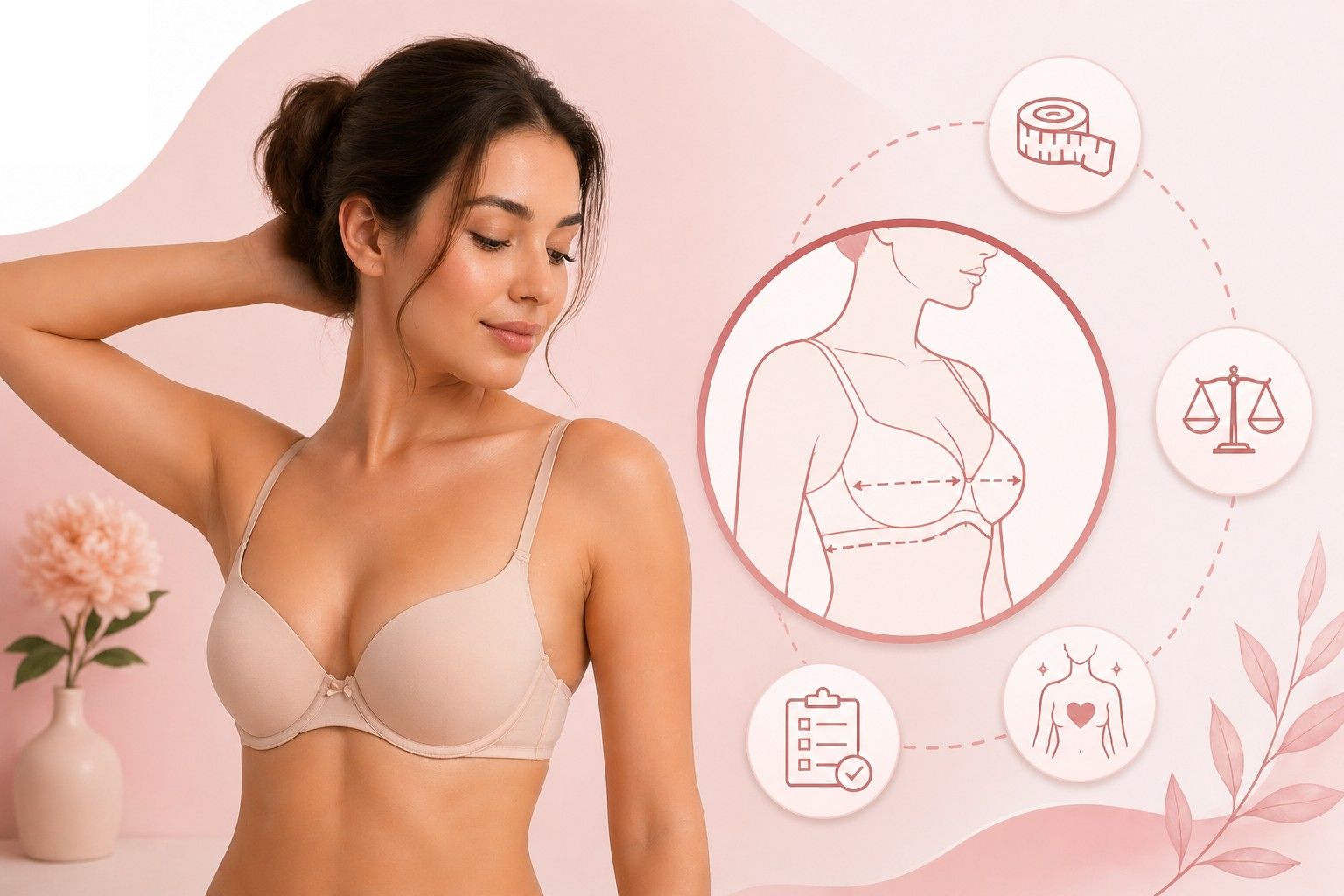
Your body constantly communicates when something is off. Here are the key physical signals that your current breast size or bra fit may need attention:
- Persistent back, neck, or shoulder pain, especially in the upper and mid-back region
- Deep grooves cut into your shoulders from bra straps
- Skin irritation, rashes, or chafing beneath the breast or along the band line
- Difficulty exercising comfortably, running, or participating in physical activity
- Postural changes such as forward rounding of the shoulders or a hunched upper back
- Headaches linked to muscle tension in the neck and upper back
These are not minor inconveniences. Chronic discomfort from poorly fitting bras or a breast size out of proportion with your frame can affect spinal health over time. If you experience any of these regularly, it is worth a thorough reassessment.
In some cases, especially when discomfort becomes chronic, medical options such as breast lift surgery are considered to relieve physical strain and improve quality of life.
Visual Proportions: How to Know If Your Size Suits Your Body
Proportion is not about matching a fashion ideal. It is about visual balance. When your bust is in harmony with the rest of your frame, you tend to carry yourself with more ease and feel more at home in your clothes.
Key proportion checkpoints:
- Shoulder width: Your bust should not extend significantly wider than your shoulders when viewed from the front
- Hip balance: A classic hourglass proportion places the bust and hips at roughly equal widths with a narrower waist in between
- Torso length: A shorter torso can feel overwhelmed by a very full bust, while a longer torso often accommodates more volume comfortably
- Overall symmetry: Most women have a slight natural asymmetry between breasts. A difference of one cup size or less is entirely normal
These are visual cues, not rules. The aim is to help you understand why you feel more balanced at certain sizes and to guide decisions about fit, style, and if relevant, surgical adjustment.
Practical Fit: The Bra Size Mistake Most Women Make
Getting your bra size wrong is extraordinarily common. The most frequent errors include wearing a band that is too loose, a cup that is too small, or both simultaneously.
Signs your bra fit is wrong:
- You are constantly adjusting your straps or pulling the band down
- Breast tissue spills over the top or sides of the cup
- The band rides up at the back instead of sitting level
- There are gaps between the cup and your breast
- Clothes fit poorly over your chest because of uneven distribution
A properly fitted bra should feel snug but comfortable on the loosest hook when new. The underwire, if present, should sit flat against your ribcage and enclose all breast tissue. The center panel should lie flat between your breasts.
Step-by-Step Guide: How to Know Your Bra Size Correctly
Learning how to know your bra size accurately takes about five minutes and a soft measuring tape. Here is the full process:
Step 1: How to Measure Band Size
Stand upright and breathe normally. Wrap the tape measure around your ribcage, directly under your bust. The tape should be snug but not tight. Round to the nearest whole number. If the number is even, that is your band size. If it is odd, round up to the next even number (for example, 31 inches becomes a 32 band).
Step 2: Bust Size Measurement
Keep the tape measure loose and wrap it around the fullest part of your bust, usually across the nipple line. Make sure the tape is parallel to the ground. Note this measurement. This is your bust size to bra size starting point.
Step 3: How to Know Your Bra Cup Size
Subtract your band size from your bust measurement. The difference determines your cup size. This is how to know your bra cup size at home:
| Difference (inches) | Cup Size |
| Less than 1″ | AA |
| 1″ | A |
| 2″ | B |
| 3″ | C |
| 4″ | D |
| 5″ | DD / E |
| 6″ | DDD / F |
| 7″ | G |
Bra Cup Size Measurements Explained
Cup size is always relative to band size. A 34C and a 36B actually contain the same breast volume, a concept called sister sizing. This means if a 34C feels right in the cup but too tight in the band, try a 36B. The cup volume stays the same while the band gives more room.
Bust Size to Bra Size: Understanding the Connection
Many women assume the cup letter is the most important number. In reality, the band size does most of the heavy lifting. Approximately 80% of bra support should come from the band, with the straps providing the remaining 20%.
Understanding the bust size to bra size relationship also helps when shopping across brands, as sizing can vary internationally:
| US Size | UK Size | EU Size | FR/ES Size |
| 32A | 32A | 70A | 85A |
| 34B | 34B | 75B | 90B |
| 36C | 36C | 80C | 95C |
| 38D | 38D | 85D | 100D |
| 40DD | 40DD | 90E | 105E |
How to Know If Your Breast Size is Perfect for You
Combining all the signals above, here is a simple self-assessment framework:
- Physical comfort: No chronic pain, no skin irritation, no difficulty with exercise
- Visual balance: Your bust feels proportionate when you look in the mirror and when you dress
- Bra fit: You can find well-fitting bras without significant difficulty
- Lifestyle fit: Your breast size does not limit your activities, hobbies, or daily movement
- Emotional ease: You feel comfortable and confident in your body as it is
If enhancement is ever considered for aesthetic or reconstructive reasons, procedures like fat transfer breast augmentation are sometimes explored as a natural-looking option that uses your own body fat instead of implants.
Perfect Breast Size Based on Body Type
Petite Frame
Petite women, typically under 5 foot 4 with narrower shoulders and hips, often feel most proportionate in A to C cup sizes. A very full bust on a small frame can create the back pain and posture issues mentioned above. That said, personal preference always matters.
Athletic Build
Women with athletic frames often have less natural breast tissue and may wear A to B cup sizes. Many athletes find smaller sizes more practical for their lifestyle. Supportive sports bras become especially important for comfort during training.
Curvy Build
Women with wider hips and shoulders often feel most balanced with a fuller bust in the C to DD range. A bust that is too small for a curvy frame can sometimes feel visually top-light. Again, this is about personal proportion, not a prescription.
Pear-Shaped Build
Pear-shaped women carry more weight in the hips and thighs than the shoulders and bust. A fuller bust can help create visual balance across the body. A to C cup sizes typically work well, depending on individual build.
How to Make Boobs Look Bigger (Naturally and Safely)
If you want a fuller appearance without surgery, several effective non-invasive strategies exist:
- Improve your posture: Standing tall with shoulders back immediately lifts and projects the bust. Poor posture is the most common reason the bust appears smaller than it is
- Choose the right bra: Push-up bras, padded bras, and plunge styles add lift and projection. Make sure they fit correctly or the effect is lost
- Wear structured tops: Ruffles, embellishments, and horizontal stripes across the chest create visual fullness
- Avoid oversized clothing: Baggy tops flatten the appearance of the bust. Fitted or slightly draped styles work better
- Chest exercises: Exercises like push-ups, chest presses, and dumbbell flyes strengthen the pectoral muscles beneath the breast tissue, improving lift and definition
- Contouring: Makeup contouring techniques can visually enhance cleavage for special occasions
How to Make Boobs Smaller (Balanced and Safe)
For women with a larger bust seeking a more manageable appearance or relief from physical discomfort, these approaches can help:
- Minimizer bras: These redistribute breast tissue rather than compressing it, reducing the projected cup size by one to two sizes without discomfort
- Full-coverage styles: Higher necklines, structured jackets, and A-line silhouettes reduce visual prominence
- Dark or monochromatic clothing: Darker colours across the chest draw less attention to the bust area
- Maintain a healthy weight: Breast tissue contains a significant proportion of fat. Overall weight management can gradually reduce breast volume
- Correct posture training: Strong back and core muscles take pressure off the chest and reduce the forward prominence of the bust
- Medical options: For women experiencing significant physical symptoms from a large bust, breast reduction surgery is a well-established, effective procedure. It is considered reconstructive as much as cosmetic in many cases
Biggest Mistakes Women Make About Breast Size
- Following trends: Breast size ideals in media change by decade. Chasing a trending size is a path to perpetual dissatisfaction
- Wearing the wrong bra size for years: Many women have worn an incorrect size since their first bra. A professional fitting can be genuinely transformative
- Comparing their body to others: Body composition, bone structure, and proportions are highly individual. Comparisons rarely lead anywhere useful
- Prioritising appearance over comfort: A breast size or bra style that looks impressive but causes daily pain is not the right choice for your long-term health
- Ignoring physical symptoms: Back pain, skin irritation, and postural problems are meaningful signals, not things to push through indefinitely
When Natural Methods Are Not Enough: How Ambrosia Clinic Can Help
For women and men experiencing significant physical discomfort, disproportionate size, or changes following weight loss, pregnancy, or ageing, professional medical solutions can offer safe and lasting results. Ambrosia Clinic, based in Hyderabad, provides a full range of breast care procedures performed by experienced surgeons, with a focus on proportion, comfort, and natural-looking outcomes. Every breast surgery at Ambrosia Clinic begins with a personalised consultation to understand your unique anatomy, lifestyle, and goals. The aim is always proportion, comfort, and confidence, not a generic result.
FAQs: Perfect Breast Size and Bra Sizing
What is the perfect breast size?
There is no single perfect breast size. The ideal size for any individual is one that is proportionate to their body frame, physically comfortable, and supportive of their daily lifestyle. For some women this is a B cup; for others, a D or DD is the right balance. Proportion and comfort define perfection, not a specific measurement.
How do you know your bra size at home?
Use a soft measuring tape. First, measure your band size by wrapping the tape snugly around your ribcage, directly under your bust. Then measure your bust at the fullest point. Subtract the band measurement from the bust measurement. The difference in inches corresponds to your cup size: 1 inch = A, 2 inches = B, 3 inches = C, 4 inches = D, and so on.
How do I know my cup size in a bra?
Cup size is determined by the difference between your band size and your full bust measurement. A one-inch difference indicates an A cup, a two-inch difference a B cup, and so on up the alphabet. Remember that cup size is relative to band size. A 34C and a 36B hold the same volume of breast tissue.
Can breast size change naturally?
Yes. Breast size and shape change throughout life due to hormonal fluctuations, pregnancy, breastfeeding, weight changes, ageing, and the effects of gravity over time. This is why it is worth remeasuring your bra size every six months and after any significant body change.
How do women with larger breasts reduce discomfort without surgery?
Minimizer bras, proper posture training, back-strengthening exercises, and supportive clothing choices all help manage discomfort from a larger bust. Maintaining a healthy body weight can also gradually reduce breast volume. For significant or persistent symptoms, breast reduction surgery provides a permanent, effective solution.
Conclusion: Your Perfect Size Is Already Within You
The search for the perfect breast size ends not on a measuring tape but in how you feel. When your size is working, you stand taller, move more freely, dress more easily, and carry yourself with quiet confidence.
If pain, discomfort, or proportion are concerns, the tools in this guide can help, whether that means remeasuring for a better bra fit, adjusting your clothing choices, strengthening your posture, or exploring professional options.
Your body is not a trend. It is not a before-and-after comparison. It is the place you live every single day. Treating it with informed care, choosing proportion over perfection, and listening to what it tells you: that is the foundation of genuine confidence.
If you are ready to explore personalised solutions, Ambrosia Clinic‘s specialist team is available for a private, no-pressure consultation to help you understand your options and make the choice that is right for you.