Medically reviewed by Dr. M Haritha, Dermatologist & Aesthetic Physician, Ambrosia Clinic, Hyderabad
You spot the first one in the mirror, or worse, someone else points it out for you. By the time you’re styling around three or four greys at 24, the questions start spiraling: Is this normal? Is it genetic? Did I cause this? Can it be undone?
Search “premature grey hair causes” and you’ll mostly find two kinds of answers: hair-oil brands promising to “reverse” greying with curry leaves and onion juice, or dry medical text that doesn’t actually tell you what to do next. Neither is built for the person standing in front of a mirror at 2 PM on a Tuesday, doing the math on how many greys is “too many” for 28.
So here’s the honest version — what actually causes premature greying, which causes you can do something about, which ones you can’t, and what a expert dermatologist would genuinely tell you before recommending any treatment.
Is Premature Greying Actually “Premature”? Defining the Normal Range
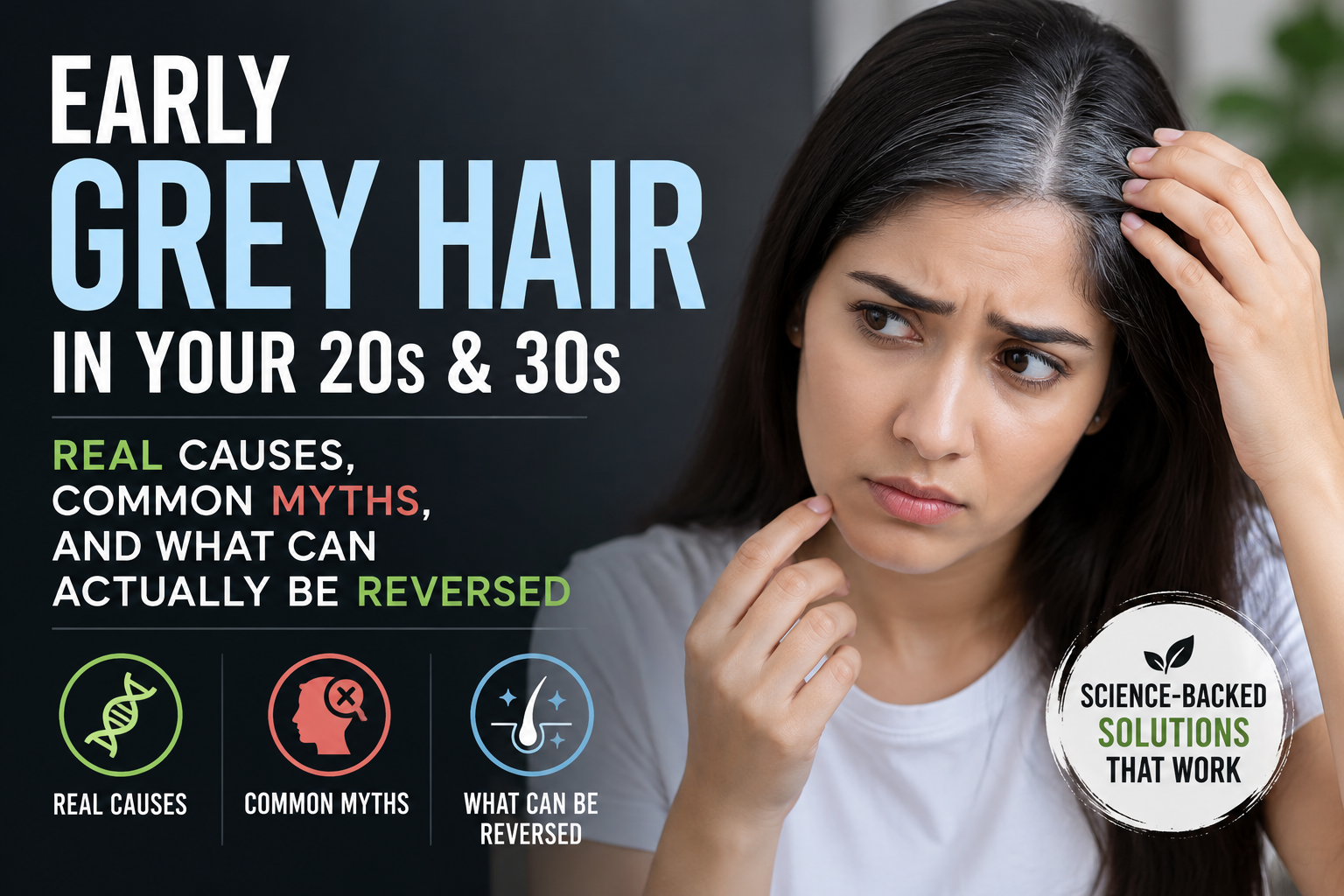
Clinically, greying is considered premature if it starts before age 20 in people of Caucasian descent, before 25 in Asian individuals, and before 30 in people of African descent. Outside premature greying, the average age hair naturally starts greying is the mid-30s for Caucasians, the late 30s for Asians, and the mid-40s for those of African descent — though a handful of stray greys in your late 20s falls within normal variation for many people.
If you’re Indian and noticing greys at 22, you’re not imagining a trend. A study of over 1,000 Indian adults under 25 found premature greying in roughly 1 in 4 of them, with genetics, smoking, and a sedentary lifestyle standing out as independent risk factors. In other words: this is common, it’s increasingly common in young Indians specifically, and in most cases it isn’t a medical emergency. But “common” and “always harmless” aren’t the same thing — which is why the rest of this guide separates the two.

The Real Causes, Ranked by How Common They Are
Most patients arrive expecting one dramatic cause — stress, a deficiency, “bad water.” In reality, dermatologists usually find one of four overlapping drivers, roughly in this order of likelihood:
1. Genetics
This is, by a wide margin, the single biggest predictor. If a parent greyed early, you have a meaningfully higher chance of doing the same, often at a similar age and starting in a similar pattern (commonly the temples first). Researchers have also identified specific genetic variants linked to early greying. If genetics is the main driver in your case, this is the one cause on this list that current dermatology cannot reverse — more on what that actually means further down.
2. Nutritional Deficiencies (B12, Iron, Copper)
Vitamin B12 deficiency and grey hair are genuinely linked, particularly in people who are vegetarian, vegan, or have an undiagnosed absorption issue (a condition called pernicious anaemia). Low ferritin (iron stores), low vitamin D, and — less commonly — copper deficiency have also shown up repeatedly in studies of young adults with early greying. This is the most “fixable” category on this list, because deficiencies show up clearly on a blood test and respond to correction.
3. Thyroid and Autoimmune Conditions
Both an underactive and overactive thyroid are associated with premature greying, as are certain autoimmune conditions. This matters because thyroid dysfunction is common, frequently under-diagnosed in your 20s and 30s, and treatable — but only if someone actually checks for it instead of assuming the greying is “just genetic.”
4. Smoking and Oxidative Stress
Multiple studies — including research specifically on Indian populations — have linked smoking to earlier and more extensive greying, most likely through oxidative stress damaging the pigment-producing cells in the hair follicle. Sedentary lifestyle and poor sleep have shown similar, if weaker, associations in recent research.
Myth Check: Does Stress Actually Turn Hair Grey?
It’s not a myth — but it’s also not the cinematic “grey overnight” story most people imagine. A widely cited 2020 Harvard study found that in mice, acute stress triggers a stress hormone (norepinephrine) that causes pigment-producing stem cells in the hair follicle to activate, migrate away, and deplete — directly causing new hair to grow in without colour.
What makes this genuinely interesting is a 2021 Columbia University study on real human hair: researchers found that individual white hairs could naturally regain pigment when a person’s reported stress went down, and lose it again when stress spiked — tracked on the very same hair strand. That doesn’t mean meditating will turn your whole head black again. It means the relationship between stress and pigment is more dynamic than “stress causes permanent damage, full stop” — and chronic, unmanaged stress is still worth addressing for reasons that go well beyond your hair colour.
Can Grey Hair Turn Black Again? What’s Realistic
For most adults, no — not for hair that’s already grey, and not as a permanent, whole-head change. Once the pigment-producing stem cells in a follicle are genuinely depleted (the typical mechanism in age-related and genetic greying), that follicle does not currently have a medical way to restart natural pigment production. Anyone promising guaranteed, permanent reversal of established grey hair is overselling what dermatology can currently do.
Where reversal genuinely happens, it tends to fall into a few specific situations:
- Deficiency-driven greying: there are documented clinical case reports of hair regaining some pigment after correcting a significant B12, iron, or copper deficiency — particularly in younger patients where the greying is recent.
- Thyroid-related greying: treating the underlying thyroid condition has, in some cases, been associated with partial repigmentation.
- Stress-linked greying: as above, isolated hairs have been documented regaining colour when major life stress resolves — interesting, but not yet a reliable clinical treatment you can book.
The honest takeaway: if your greying has a fixable cause and you catch it early, partial improvement is realistic. If it’s primarily genetic or age-related, the goal shifts from “reversal” to “management” — and that’s not a disappointing answer, it’s an accurate one.
When Premature Greying Needs a Blood Test, Not Just a Hair Oil
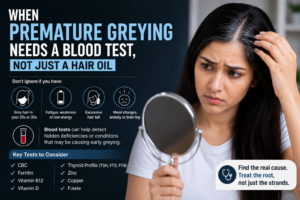
Most premature greying doesn’t need urgent investigation. But it’s worth seeing a dermatologist for a proper assessment — usually starting with a simple blood panel — if you notice:
- Greying well before the typical age range for your background (see the thresholds above)
- Sudden, rapid greying over weeks rather than a gradual pattern over years
- Greying alongside fatigue, pale skin, or tingling in the hands or feet (possible B12 signs)
- Greying alongside unexplained weight change, hair thinning, or fatigue (possible thyroid signs)
- A strong family history of autoimmune conditions
- Patchy white patches on the skin alongside the hair changes (worth ruling out alongside greying, not assuming)
A basic workup typically checks vitamin B12, ferritin/iron studies, vitamin D, and thyroid function (TSH) — inexpensive tests that either rule out a fixable cause or confirm that genetics is doing the driving, so you’re not guessing.
Treatments That Can Help (and Their Limits)
This is the section most “miracle cure” content skips, because the honest version is less exciting than a bottle with a 30-day guarantee.
- Correcting a confirmed deficiency. If bloodwork shows low B12, iron, or vitamin D, supplementation under medical guidance can help — but only if a real deficiency exists. Taking B12 supplements when your levels are already normal will not turn existing grey hairs black; this is one of the more common and avoidable mistakes people make.
- Managing thyroid or autoimmune conditions. Treating the underlying condition is the actual intervention here — not a topical product.
- Reducing oxidative stress contributors. Quitting smoking, improving sleep, and general antioxidant-supportive nutrition won’t reverse existing grey strands, but the evidence suggests they may slow how quickly new ones appear.
- PRP (Platelet-Rich Plasma) for hair. PRP is well-studied for improving hair density and follicle strength in thinning hair, and there’s growing clinical interest in its effect on follicle health more broadly. Be cautious of anyone marketing PRP as a guaranteed grey hair reversal treatment — the evidence specifically for pigment restoration is still early and limited. A dermatologist should set realistic expectations before recommending it for this purpose.
- Cosmetic camouflage. Semi-permanent colour, root touch-ups, and henna remain the most reliable, immediate way to address the cosmetic concern while any underlying cause is being investigated or treated — and there’s nothing wrong with choosing this option on its own.
What doesn’t hold up: the idea that plucking a grey hair makes more grow back (each follicle produces one hair regardless of plucking), and most “ayurvedic reversal” oils with no clinical evidence behind the specific claim of repigmentation.
Are you Worried about your early greying?
A simple consultation can check for treatable causes — like a deficiency or a thyroid issue — instead of leaving you to guess between hair oils. Book a Dermatology Assesment with the dermatology team at Ambrosia Clinic, Banjara Hills, Hyderabad.
FAQs
Q1. What age is it normal to start getting grey hair?
Ans. For most Indians (classified as Asian in dermatology literature), greying is considered premature before age 25, with the average natural onset in the late 30s. A few isolated greys in your mid-to-late 20s is common and not automatically a red flag.
Q2. Can grey hair go back to its natural colour on its own?
Ans. Rarely, and usually only when an underlying cause — a deficiency, a thyroid issue, or a period of high stress — is identified and resolved. Genetic or purely age-related grey hair does not currently reverse on its own.
Q3. Does plucking grey hairs make more grow back?
Ans. No. Each hair follicle is an independent unit; removing one hair has no effect on the pigment production of neighbouring follicles. It’s a long-standing myth with no biological basis.
Q4. Which vitamin deficiency is most linked to grey hair?
Ans. Vitamin B12 deficiency has the strongest documented link, followed by low iron (ferritin) and vitamin D. A simple blood test can confirm whether any of these apply to you.
Q5. Is premature greying a sign of an underlying health problem?
Ans. Usually not — most cases are genetic. But because it can occasionally be an early sign of thyroid dysfunction, anaemia, or a vitamin deficiency, it’s worth a one-time check, especially if it’s sudden, early, or accompanied by other symptoms.
Q6. Can PRP treatment reverse grey hair?
Ans. PRP has solid evidence for improving hair density and follicle health, but evidence specifically for reversing grey hair is still preliminary. It shouldn’t be sold as a guaranteed pigment-restoring treatment.